If Ypu Make a Red Off the Break in Snooker to You Get to Go Again
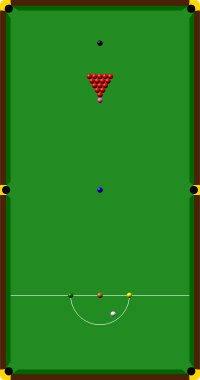
Snooker tabular array, fatigued to scale, with starting positions of all object assurance and the cue brawl placed within the "D" for a break-off shot.
Snooker is a cue sport that is played on a baize-covered tabular array with pockets in each of the 4 corners and in the center of each of the long side cushions. It is played using a cue and snooker balls: 1 white cue ball , 15 red assurance worth one betoken each (sometimes played with fewer red balls, commonly 6 or 10), and half dozen balls of different colours : yellow (2 points), greenish (three), brown (4), blue (v), pink (6), black (7).[ane] A player (or team) wins a frame (individual game) of snooker by scoring more points than the opponent(s), using the cue ball to pot the cherry and coloured balls. A player (or team) wins a match when they have achieved the best-of score from a pre-adamant number of frames. The number of frames is always odd so as to prevent a tie or a draw.
The table [edit]
Snooker is played on a rectangular snooker table with six pockets, one at each corner and one in the heart of each long side. The table usually has a slate base, covered in green baize. A baulk line is drawn across the width of the tabular array, 29 inches (74 cm) from the cushion at ane end; these ii latter items are respectively designated equally the baulk cushion and baulk terminate. A semicircle of radius 11+ 1⁄2 inches (29 cm), called the D, is drawn behind this line, with its middle on the midpoint. The cushion at the other end of the tabular array is known as the top absorber.
A regulation (full-size) table is 12 ft × half dozen ft (3.seven m × ane.8 1000); because of the large size of these tables, smaller tables are common in homes, pubs and other places where space is limited. These are ofttimes around 6 anxiety (1.viii m) in length, with all the dimensions and markings scaled downwardly accordingly. The balls used are sometimes too scaled down, and/or reduced in number (in the case of the reds) by omitting the longest row of assurance in the rack.
The balls [edit]

Pack of reds, not touching the pinkish
Snooker assurance, like the balls for all cue sports, are typically fabricated of phenolic resin, and are smaller than American pool assurance. Regulation snooker balls (which are specified in metric units) are nominally 52.5 mm (approximately 2+ 1⁄15 inches) in diameter, though many sets are actually manufactured at 52.4 mm (almost ii+ i⁄16 in). No weight for the balls is specified in the rules, only that the weight of any 2 balls should non differ past more 0.5 g. Some recreational sets (which are usually not measured metrically) are 2+ one⁄8 in (about 54 mm) up to every bit large as pool balls, at 2+ 1⁄4 in (almost 57.2 mm); larger ball size requires wider pocket openings. Miniature sets as well exist, for half-size habitation tables. There are fifteen crimson balls , vi "colour" balls (yellow, green, brown, blueish, pinkish, and blackness), and one white cue ball . Ordinarily none of the balls are numbered, though the six colour balls often are in the US, where they are easily mistaken at first glance for pool assurance (the pattern is similar, but the numbering does not match pool'southward scheme).
At the beginning of a frame, the balls are set in the arrangement shown in the illustration. The six colours (a term referring to all assurance except the white and the reds) are placed on their ain spots. On the baulk line, looking up the table from the baulk end, the dark-green ball is located where the "D" meets the line on the left, the brown ball in the heart of the line, and the xanthous ball where the "D" meets the line on the right. This social club is often remembered using the mnemonic God Anoint You, the first letter of each word being the first letter of the three colours (Green, Brownish, Yellow). The blueish ball rests at the exact center of the table, while the pink is placed midway betwixt it and the top cushion. The red balls are arranged in a tightly-packed triangle behind the pink, with the apex every bit shut every bit possible to the pink merely not touching it. Finally, the black ball is placed on a spot 32.5 cm (12.8 in) from the superlative cushion, centred from left to right and then that the brown, blue, pinkish, and blackness balls all sit on an imaginary line that bisects the table along its length.
Objective [edit]
The objective of the game of snooker is to strike the white cue ball with a cue so that it strikes the object balls in plow and causes them to fall into 1 of the 6 pockets. Points are scored for potting balls legally, in accordance with the rules described below, or in the issue of a foul committed by the opponent. The player who scores more points wins the frame, and the start role player to win a set number of frames wins the match.
Match [edit]
A lucifer commonly consists of a fixed, odd number of frames. A frame begins with setting up the balls as described above. A frame ends when all balls are potted, or when 1 of the players concedes defeat due to being too far behind on points to tie or beat the opponent's score.
A friction match ends when one player has won enough frames to make it impossible for the other histrion to take hold of up. For example, in a friction match of 19 frames, the kickoff player to win 10 of them is the victor.
Gameplay [edit]
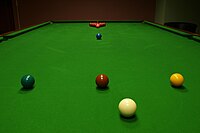
Snooker tabular array with all assurance at the start of a frame. The cue ball has been placed inside the D for a pause-off shot.
At the beginning of each frame, the balls are set by the referee as explained. The frame begins with one player taking the cue ball in-hand, placing it anywhere on or inside the D and attempting to hit one or more than of the crimson balls on an initial suspension-off shot. A common strategy for this shot involves placing the cue ball on the baulk line, between the brown ball and either the green or xanthous ball. The break-off alternates between players on successive frames.
But ane thespian may visit the table at a fourth dimension. A break is the number of points scored by a player in one unmarried visit to the tabular array. A thespian'due south plough and break finish when he or she fails to pot a ball or does something confronting the rules of the game (called a foul), or when a frame has ended.
The ball or balls that can exist hit offset past the cue brawl are called the ball(s) "on" for that particular stroke. The ball(s) "on" differ from shot to shot: a red ball, if potted, must be followed by a colour, a potted colour must be followed by a red, and then on until a interruption ends. If a red is not potted, any blood-red ball remains the ball "on" for the opponent's first shot. But a ball or balls "on" may be potted legally by a player; potting a brawl not "on" constitutes a foul. All of the reds are "on" for the break-off shot, and for the starting time shot of any turn in which one or more reds are nevertheless on the tabular array.
If the cue ball comes to rest in directly contact with a ball that is on or could be on, the referee shall declare a "touching brawl". The striker must "play away" from that ball without moving information technology, but is not required to hit any other ball because the touching ball is on. If the object ball moves, it is considered a "button shot" and a foul is chosen. No penalization is incurred for playing away if:
- The brawl is on. Example: Striker pots a colour, making the reds on for the side by side shot, and the cue ball comes to rest touching one of them.
- The ball could be on and the striker nominates information technology every bit on. Example: Striker pots a red, cue brawl comes to rest touching the green, and the striker declares that ball as on.
- The brawl could be on, and the striker nominates another ball as on and hits it first. Example: Striker pots a carmine, cue brawl comes to balance touching the green, and the striker declares the black equally on and hits information technology first.
If the cue ball is touching some other brawl which could not be on (east.g. touching a colour when the striker must pot a cherry, or vice versa), a touching ball is non called, and the striker must play away from it and hit a legally nominated object ball. Where the cue ball is simultaneously touching several assurance that are on or could be on, the referee shall signal that each and every one of them is a touching brawl; the striker must therefore play abroad from all of them.
The striker scores no points for assurance potted as the issue of a foul. Depending on the situation, these balls will either remain off the tabular array; be returned to their original spots; or be replaced in the positions they occupied earlier the foul shot, along with any other balls that were moved during the shot. For details on such situations, see Fouls below.
Each frame of snooker more often than not consists of two phases. The beginning stage lasts as long as whatever ruddy balls remain on the table. During this phase, all cherry assurance are "on" for the beginning of a player'south turn; the player must therefore first striking and attempt to pot one or more of them. If the player either commits a foul or fails to pot a carmine, the plough ends and the opponent begins to play.
| Colour | Value |
|---|---|
 Red Red | 1 signal |
 Yellowish Yellowish | 2 points |
 Greenish Greenish | 3 points |
 Dark-brown Dark-brown | 4 points |
 Blue Blue | 5 points |
 Pink Pink | 6 points |
 Blackness Blackness | 7 points |
Each legally potted ruby-red ball awards one point and remains off the table until the end of the frame. The player continues his or her turn by nominating one of the six colours (yellow, greenish, brown, blue, pink, black) as the ball "on" for the next shot. The rules of the game indicate that the player must state the desired colour to the referee, although it is unremarkably articulate which ball the player is attempting to pot, making a formal nomination unnecessary unless the referee insists on it.
Potting the nominated color awards further points (ii through seven, in the same lodge as the preceding paragraph). The referee so removes the colour from the pocket and replaces it on the table in its original spot. If that spot is occupied (that is, if the ball cannot exist placed on information technology without touching another ball),[2] [iii] then the brawl is placed on the highest available spot. If all spots are occupied, it is placed as shut to its own spot as possible in a direct line between that spot and the top cushion, without touching some other ball.[2] If there is no room this side of the spot, it volition be placed as close to the spot as possible in a straight line towards the bottom cushion, without touching another brawl. The player then resumes play, with the red assurance "on" again.
Because only one of the colours can exist "on" at whatever given time, it is a foul to first hitting multiple colours at the same time, or pot more than than 1 colour (unless a gratis ball has been awarded; run into below).
If a thespian fails to pot a brawl "on", whether a blood-red or a nominated color, the other player will come up to the table, with the reds always existence the balls "on" equally long every bit there are nonetheless reds on the tabular array.
The alternation between ruddy balls and colours ends when all reds have been potted and an attempt (successful or not) to pot a color is made after the last red is potted, or when the last cherry-red is potted or knocked off the table as the result of a foul and is non replaced. All 6 colours accept then to exist potted in ascending order of their value (yellowish, green, dark-brown, blue, pinkish, black). Each becomes the brawl "on" in that order. During this phase, the colours are not replaced on the tabular array after being legally potted; however, any colour potted as the result of a foul is re-spotted.
After all 6 colours have been potted, the histrion with the higher score wins the frame (only see below for end-of-frame scenarios).
Fouls [edit]
A foul is a shot or action past the striker which is against the rules of the game. When a foul is fabricated during a shot, the player's turn ends, and no points are awarded for any balls potted on that shot. Mutual fouls are:[4] [5]
- Failing to hitting whatsoever other ball with the cue ball.
- First striking a brawl "not-on" with the cue ball.
- Potting a ball "not-on".
- Potting the cue ball (in-off).
- Touching any object ball with anything but the cue brawl.
- Touching whatever ball earlier all balls accept come up to a complete stop.
- Hit the cue ball more than once on the same shot.
- Making a ball land off the table.
- Touching the cue ball with anything other than the tip of the cue. The exception is that while positioning the cue ball "in-hand"; it may be touched by annihilation except the tip of the cue.
- Playing a "push shot" – a shot in which an object ball (whether "on" or not) in straight contact with the cue ball moves when the cue brawl is hit, unless the cue ball hits a very fine edge of the object ball.
- Playing a "jump shot" – a shot where the cue ball leaves the bed of the tabular array and jumps over whatsoever office of a ball before offset hitting some other ball.
- Playing a shot with both feet off the ground. The player may lean over the table, support a portion of his or her weight on it, and/or use a mechanical bridge as desired, only at least i pes must remain in contact with the footing.
When a player commits a foul and the cue ball remains on the tabular array, the opponent may either play from the resulting position or, if he considers information technology to be disadvantageous, request that the offender play again. If the cue brawl is potted or leaves the table, the opponent receives it "in-hand" and may so place it anywhere within the "D" for the next shot.
It is sometimes erroneously believed that potting two or more assurance in one shot is an automatic foul. This is only true if one of the potted assurance is non "on" (east.thou. a red and a colour, or two different colours). When the reds are "on", two or more of them may be legally potted in the aforementioned shot and are worth one signal each; however, the role player may only nominate and attempt to pot one colour on the next shot. If a free ball has been granted (see below), a color may exist legally potted in the aforementioned shot as a red or another color, depending on the circumstances.
Should a cue ball exist touched with the tip while "in-hand", i.e. when breaking-off or playing from the "D" later on being potted or knocked off the tabular array, a foul is not committed every bit long as the referee is satisfied that the actor was only positioning the ball, and not playing a shot or preparing to play 1.
The post-obit fouls award 7 points to the opponent when committed:[i]
- Touching an object brawl with annihilation other than the cue brawl
- Playing at reds, or a free ball followed by a red, in successive strokes
- Declining to declare which ball is "on" when requested to do so by the referee
- After potting a red or costless ball nominated as a red, committing a foul earlier nominating a colour
- Using a ball off the tabular array for whatever purpose
- Using any object to measure out gaps or distance
Whatever other foul awards points to the opponent equal to the value of the brawl "on", the highest value of all balls involved in the foul, or four points, whichever is highest. If multiple fouls are committed in one shot, only the punishment for the highest-valued foul is scored. The penalisation for a foul is thus no lower than iv points and no college than vii.
Non hitting the ball "on" commencement is the virtually common foul. A common defensive tactic is to play a shot that leaves the opponent unable to hit a ball "on" direct. This is most commonly called "snookering" ane'south opponent, or alternatively "laying a snooker" or putting the other player "in a snooker".
Because players receive points for fouls by their opponents, repeatedly snookering i'south opponent is a possible mode of winning a frame when potting all the assurance on the tabular array would be insufficient to ensure a win or tie. This portion of the frame is known every bit the "snookers-required" stage.
Free ball [edit]

Free brawl state of affairs, with the red on just snookered by the blackness.
A gratis ball is a actor-nominated substitute for the brawl "on" when a actor becomes snookered as the result of a foul committed by the opponent.[1] The snooker is considered illegitimate in this case, and the affected player is immune to nullify information technology past nominating any object ball as being "on" for the first shot of his/her turn. One time the free brawl shot is taken legally, the game continues normally; all the same, if the thespian who committed the foul is asked to play once again, a costless ball is non granted. If the free ball is potted by itself, it is respotted and the player scores the points for the bodily ball "on."
For example, every bit illustrated in the provided picture show, if the brawl "on" is the ruddy, simply is snookered by the blackness due to a foul, the fouled player volition be able to name any colour as the costless ball. The role player could and then pot the chosen colour equally if it were a scarlet for ane point. The colour volition so exist respotted, the player will nominate a colour to be on for the side by side shot, and normal play volition resume.
As a natural corollary of the rules, the free ball is e'er a colour ball. If the brawl on is a red, then by definition it cannot be snookered via another ruby-red, as it merely provides an alternative clean shot with another ball on. If the brawl on is a cerise, and is snookered by a color after a foul, then logically the scarlet is either the concluding one or all reds are snookered past a colour ball, meaning the free ball has to be a colour. If the ball on is a color ball that is snookered by a red, a previous reddish must have been successfully potted; the snooker therefore must be self-inflicted and cannot have occurred as the result of a foul. If the ball on is a colour that is snookered by another colour after a foul, all reds must have been already potted; thus the free ball still has to be a colour brawl.
The scoring for a shot in which both the complimentary ball and the bodily ball on are potted depends on the point in the game at which it occurs. If the reds are on and both the costless ball and one or more reds are potted, then each ball potted is scored as a ruby for one point. If a colour is on and both it and the costless ball are potted, merely the bodily ball on is scored. In both cases, the free ball volition be re-spotted and the bodily brawl(s) on will remain off the table. These two situations represent the only times when a colour can exist potted in the aforementioned shot equally a crimson or another colour without a foul occurring.
The player may hit the gratis ball into the actual ball on in order to pot the latter, referred to equally planting. Going back to the motion-picture show above, the player could nominate the black every bit the complimentary ball and use it to plant the real red. If the player potted both balls in ane shot, two points would be awarded and the black would be re-spotted. A foul is committed if the role player fails to strike the free ball either first by itself, or simultaneously with the bodily brawl on.
Failing to pot the free ball incurs no punishment, so the striker may play a snooker using the costless brawl if desired. Nonetheless, if said snooker is achieved by having the free ball obstructing the ball on, so the strike is a foul and a punishment of the value of the brawl on is awarded to the opponent. The reason is that the complimentary ball was to be treated as the ball on, and one cannot snooker a brawl on by another ball on (post-obit the aforementioned logic that a ruby cannot snooker another red when red is on). The only exception to this is when there are only ii balls remaining on the table, namely pink and black. If the opposition somehow fouled trying to pot pink, and illegitimately snookered the striker with the black, then it is off-white for the striker to snooker the opposition "back" with the free black ball.
A free ball scenario does not occur when the ball gets stuck at the edge of a pocket jaw (commonly referred to as "angled") in such a fashion that the player is unable to hit any brawl on. This is because according to the official snooker rules a ball is snookered only if its way is obstructed by balls not on. In this scenario, afterwards a foul, the actor may choose to either have the shot from the current position or ask the offender to play over again, every bit per the usual rules on fouls.
Foul and a miss [edit]
A foul and a miss will be called if a player does not hit the ball "on" first (a foul) and is deemed past the referee to accept not made the all-time possible attempt (a miss). In this case, the opponent has the choice to request that all balls on the table exist returned to their position before the foul, and crave the fouling player to have the shot again.
The rule was introduced to prevent players from playing professional fouls (i.due east., deliberately fouling so every bit to leave the balls in a safe position, reducing the risk of giving a frame-winning chance to the opponent). Multiple misses often occur considering players endeavour to hitting a shot very softly or thinly in situations where a fuller contact might exit their opponent an like shooting fish in a barrel potting chance. This can lead to an apparently easy escape beingness attempted several times, as players feel that it is meliorate to concede many points just leave a safe position, than concede none and leave a frame-winning hazard.
In practice, the "all-time endeavor" decision consists of three key elements that are hands applied objectively:
- Whether the player's choice of shot is the easiest to exist achieved. If a role player deliberately attempts a difficult shot with an easier escape available, intention to leave the opponent a bad position later a foul is presumed, and thus a miss will be called.
- Whether the cue ball has been hit with sufficient strength to reach the ball "on". Undershooting almost always results in a miss, as intention to leave the opponent in a bad position after a foul is once more presumed in this case.
- Whether the player has tried to get the cue ball every bit close to the ball "on" as possible.
All 3 of these elements must exist nowadays in order for the referee to determine that a player has made his or her all-time effort.
There are 3 situations in which a miss will not be called, even if the referee decides that a all-time endeavor has not been made:
- If either thespian needs penalty points to win a frame, or if either histrion would need them later on the current penalty is practical. This is to prevent the players from running upward the score due to repeated misses in worst-instance scenarios.
- If the score difference is equal to the number of points still on the table, either before or afterwards the punishment is applied, and the referee believes that the foul was not intentional. This is to prevent the score difference from decreasing too much, at the referee's discretion.
- If information technology is physically impossible to play a legal shot (the snooker is truly inescapable, as judged past the referee). The player must still put sufficient strength into the shot so that the cue ball would be able to reach its target if it were non obstructed, and endeavour a shot that could succeed if the obstruction were not present.
If a player fouls and misses in a non-snookered scenario, and if the opponent requests that the shot exist replayed from the original position, a 2d failure to brand a best try is ruled a foul and a miss regardless of the score difference. The fouling actor is issued a warning past the referee, and a third such failure forfeits the frame to the opponent. A foul after such a alert is very rare.
The cease of a frame [edit]
A frame normally ends in 1 of three ways.
- A concession, in which one player gives up due to being also far backside to have a realistic run a risk of winning the frame. Concession before the snookers-required stage may be interpreted equally unsporting conduct and result in a penalization of a second frame existence applied.[1]
- The final black is potted legally (including after a re-spot), and this does not leave the score tied.
- The striker leads by more than vii points with but the black remaining. They may claim the win at this point, merely may also elect to pot the black despite having won the frame afterwards potting the pinkish. This may be washed if the striker wishes to consummate a high-scoring pause (run into "Maximum intermission" below).
There are three less common means to end a frame:
- A foul on the blackness, when the black is the only ball left. It is sometimes wrongly assumed that play continues afterward a foul on the black if there are fewer than seven points between the scores. This is not the case: the thespian who is in the lead following the assessment of a penalty after a foul, when only the black remains, becomes the winner.[1]
- Failure to hitting a ball "on" 3 times in a row, if the actor has a articulate sight of the ball. The referee will warn a player after a second such miss that a third miss will hateful that the opponent volition be awarded the frame. This rule does not apply if the player is snookered. As missing due to avoiding a direct shot on a ball is usually a tactical, rather than skill-related, outcome, this dominion is rarely invoked, as a player will merely hit the brawl direct on the 3rd shot.[1]
- A histrion may incur a verbal warning if the referee deems that he or she is taking also long to shoot. Additional hesitation may forfeit the frame to the opponent at the referee'south discretion.
If the score is tied after the final black is fouled or potted, the black is re-spotted. The winner of a coin toss by the referee decides which thespian will take beginning strike at the black; that player receives the cue ball "in-manus" for his/her offset shot. Play and so continues normally until the black is potted or another frame-catastrophe state of affairs occurs.
If the players achieve a stalemate situation, as determined past either their own indication or the referee's judgment, they may choose to discard the scores from the electric current frame and restart it. Should the stalemate last for a certain period of fourth dimension as specified by the referee, the players must restart the frame.[1]
Maximum intermission [edit]
The highest break that can be made nether normal circumstances is 147. To reach it, the player must pot all fifteen reds, with the black later on every red, followed by potting all six colours.
This "maximum break" of 147 rarely occurs in match play. The fastest maximum suspension in a tournament was achieved during the Globe Championships on 21 April 1997, past Ronnie O'Sullivan against Mick Price in v minutes and 8 seconds.[six]
If an opponent fouls before whatsoever balls are potted, and leaves the actor a complimentary ball, the player tin can and then nominate a colour and play it as a red for one point, then nominate a color and pot it for its normal value. Information technology is thus possible to score for 16 reds and blacks (16 * 8), plus the values of all the colours (27), resulting in a break of 155. Nether tournament conditions, Jamie Burnett achieved 148 points.[7]
The highest possible score, every bit singled-out from the highest possible break, is unlimited and depends on the value of points scored from the opponent's foul shots when added to the player's ain scored points (which may not require the highest pause). However, the highest possible score from a unmarried visit clearance is 162 (foul on the blackness, followed by a gratis ball treated as a carmine, equally to a higher place).
References [edit]
- ^ a b c d e f g "Official Rules of the Games of Snooker and English Billiards" (PDF). The Earth Professional person Billiards & Snooker Association Limited. Nov 2019. Archived (PDF) from the original on August seven, 2020. Retrieved August xviii, 2020.
- ^ a b https://world wide web.rulesofsport.com/sports/snooker.html
- ^ https://wpbsa.com/wp-content/uploads/WPBSA-Official-Rules-of-the-Games-of-Snooker-and-Billiards-2020.pdf[ bare URL PDF ]
- ^ "Snooker Rules". Billiard Congress of America. Archived from the original on Oct 12, 2007. Retrieved May 10, 2015.
- ^ "Official Rules of the Games of Snooker and English Billiards (2019)" (PDF). wpbsa,com. World Professional person Billiards and Snooker Association. Archived from the original (PDF) on 16 August 2019. Retrieved 20 August 2019.
- ^ "Fastest 147 break in snooker". Guinness World Records. Archived from the original on July 5, 2014. Retrieved May ten, 2015.
- ^ Everton, Clive (October 17, 2004). "Burnett'due south break goes 1 better". The Guardian. Archived from the original on September 6, 2015. Retrieved May 10, 2015.
Under ordinary circumstances the maximum break is 147 (fifteen reds, 15 blacks followed by the colours in sequence) and the professional circuit has seen 49 of these. However, an "actress" red is very infrequently created by a foul which leaves a free ball with all the reds remaining on the table.
brodiedwellied1975.blogspot.com
Source: https://en.wikipedia.org/wiki/Rules_of_snooker
0 Response to "If Ypu Make a Red Off the Break in Snooker to You Get to Go Again"
แสดงความคิดเห็น